Table of Contents
Background
A deep dig into food waste and what we do with it has been fertile soil for discussion for years now. It was coming up at doors last election cycle, and it comes up regularly from neighbours at open houses, on social media, and in conversations I have around the community. But recently, someone caught my attention with a shift in the questioning: why don’t we have compost bins yet?
Often people ask it as a when or will question. The why is complicated. Because rural spaces make trucked curbside services more expensive. Because there’s a broader mix of possible solutions, some which people are already undertaking. Because we have clusters of built-up homes with long drives between and little information and which groups want what.
So I decided to gather that information.
I wrote a short survey and posted it here to my webpage. For two and a half weeks, I kept it live, and I shared it to social media groups for Belmont, Sparta, Union, Lynhurst, and Port Stanley. I was pleased to hear that some neighbours shared it to others, as well. Then, I looked at the results to try to understand what solutions are worth asking staff to take time to investigate, and what ones aren’t drawing interest, or draw too many objections.
Instead of sending a standalone motion to council, I shared a report on the data alongside it. Here’s what I learned and what I concluded.
Data
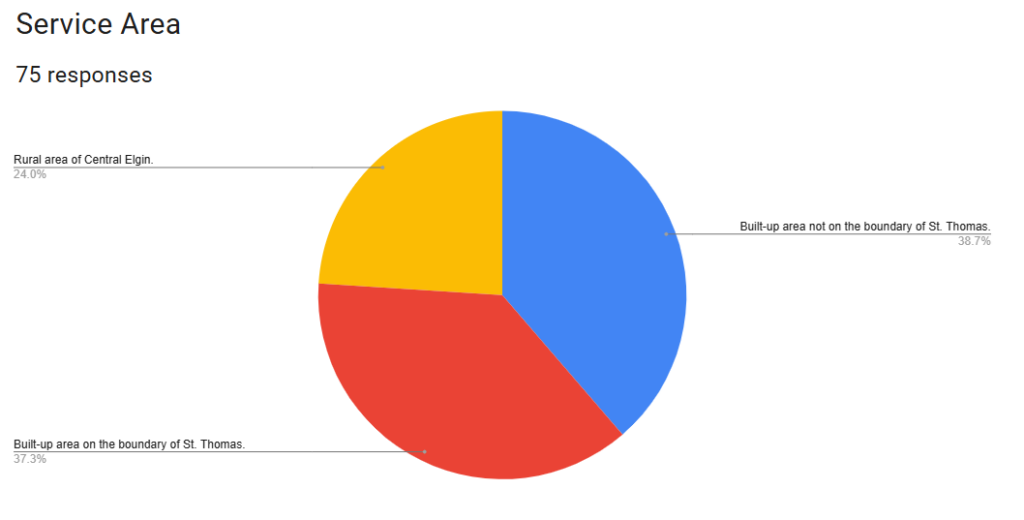
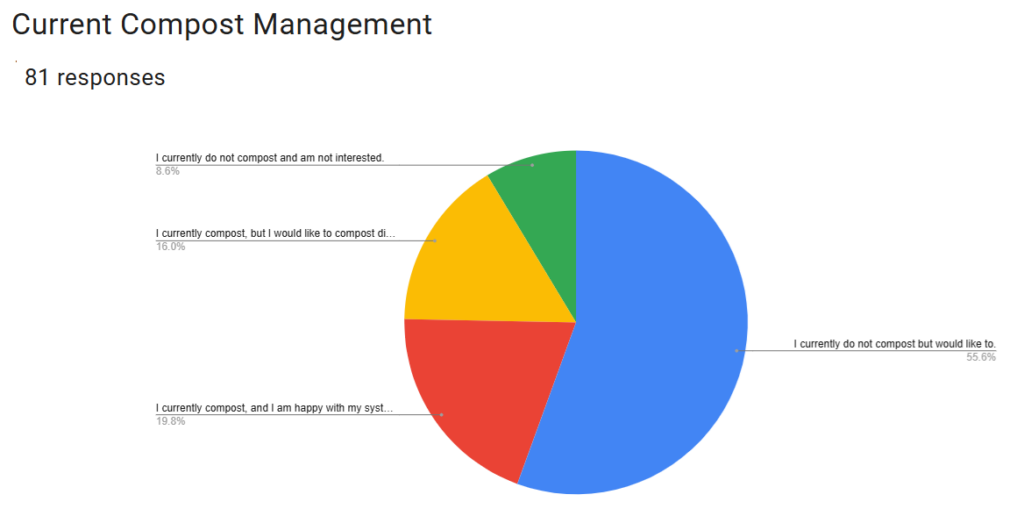
Of the 82 responses my survey received, 24% came from rural areas of the community, and respondents from built-up areas were divided evenly between those living adjacent to St. Thomas and those living in other built-up areas. 28% of respondents are happy with their current compost solutions or not interested in composting at all, and 71% would like to be able to compost or to be able to compost by a method other than backyard composting. In spite of this, 86% of respondents said that environmental stewardship is very or somewhat important. This is interesting community-specific feedback, because some of those who did not want municipal compost services objected out of concern that bin collection across large rural spaces and built-up areas where many yards can support backyard compost might be sparsely-enough used that the fuel consumption required for collection could outweigh the sustainability benefit of diverting waste from landfills. So even those objecting to compost collection are united in their desire to find the most environmentally sustainable outcome.
Interest by System Type
Common compost solutions include backyard composters, homemade or as available through our municipal office, outdoor compost tumbler systems, indoor countertop tumbler systems, and green bin collection.
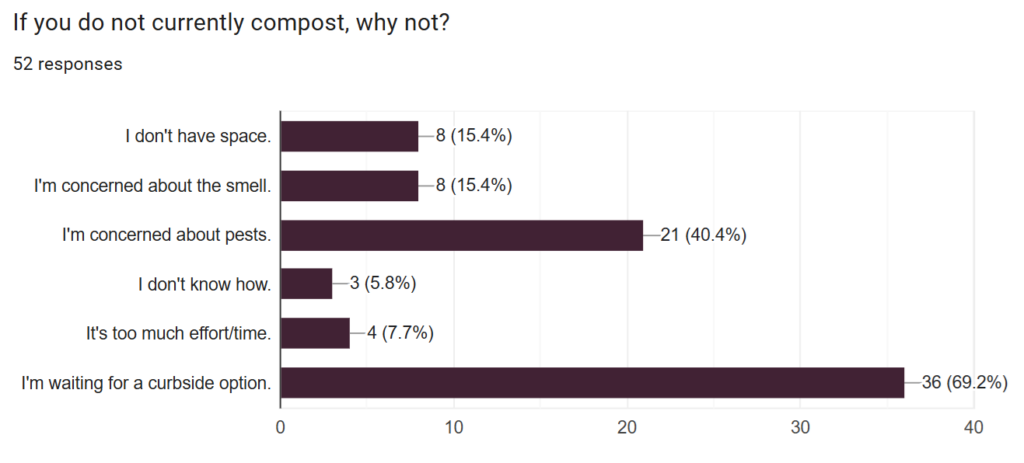
Of the total respondents, 68% were interested in the municipality implementing a green bin system, 33% were interested in outdoor tumbler systems, and 15.8% were interested in indoor tumbler systems. Of those not currently composting, 69% said they were waiting for a bin system to be available, which highlights the importance of including this option in consideration.
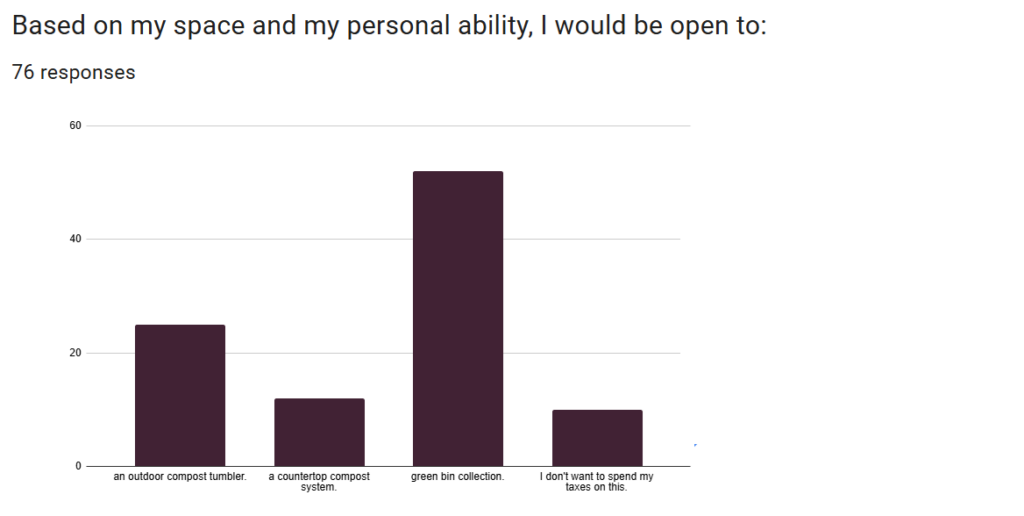
Divided by settlement type, rural respondents were more interested in outdoor tumbler systems, with 38.8% favourable, and less interested in indoor tumblers and green bin collection, at 11.1% interest and 50% interest respectively. This likely reflects the rural homes having better access to yard space suitable for composting.
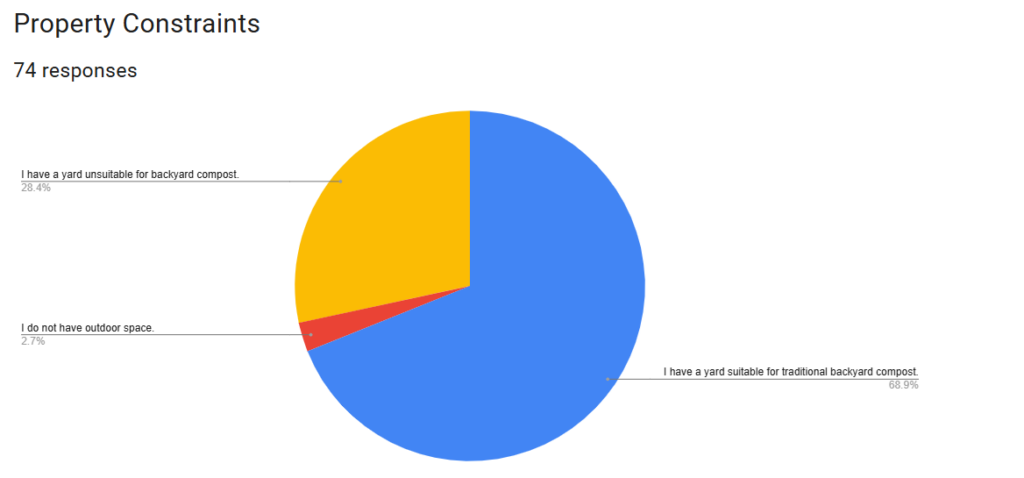
Of those who responded to both questions, 88% of rural residents felt that their yard was suitable for home compost options, whereas only 62% of respondents in built up areas felt that they had suitable space. These numbers suggest that a combination of approaches may be most effective, providing green bin service limited to built-up areas, and making outdoor tumblers available for purchase from the municipality as we currently do with plastic composters. With less interest in countertop compost systems, they might not be bulk-sourceable by the municipality at a price that would be desirable to the community.
One respondent spoke favourably of a system in another municipality, where residents dropped compost to a large bin available on key municipal premises, rather than small home bins. This option reduced the need for labour hours and fuel consumption for green bin collection at households, and still allowed residents to reduce landfill waste. This option could be considered as an alternative green bin solution.
5.8% of respondents who do not compost cited that they don’t know enough about how to compost at home. While this is not a large number, education campaigns can be very inexpensive compared to collection services. Seasonal education sessions and online education materials could be a cost effective way to improve composting outcomes, with or without other changes to our current service provision.
Cost Considerations
The city of St. Thomas provides green bin collection for its residents, and a common remark from Central Elgin residents adjacent to the city is that collection could be provided as a shared service with St. Thomas. This might be possible, and could conceivably reduce the cost of providing the service, but it might not be possible to provide as a shared service for the rural or non-city-adjacent community. For that reason, part of my survey targeted which communities desired which compost solutions. If city-adjacent residents want green bins more than residents in other parts of the community, a shared service might be possible.
One tension in the data was that although the most-desired compost solution is green bins, which incur a continuous cost to provide rather than a one-time cost for a tumbler, respondents overwhelmingly did not want to pay a continuous service fee for compost collection, responding that the cost should be incorporated into property taxes.
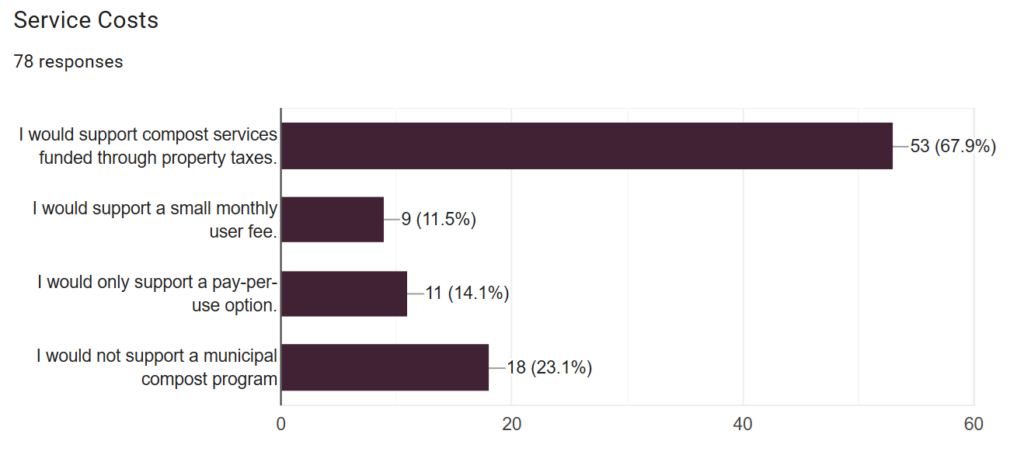
Some respondents felt that if it were included in taxes, people ambivalent to compost might still engage with the system, whereas a service fee would result only in actively interested residents using the service.
On the other hand, our Strategic Plan identifies a goal of affordability. Allowing families to decide whether to include composting service in their budget could be more considerate of individual affordability needs.
Concerns and Considerations
One of the most cited concerns on the part of residents who do not compost was pests. This is in kind with concerns presented to council by Colleen Burns from Fur Ever Wild about wild animals being attracted into town when humans feed them. If an investigation of options is undertaken, it would be ideal to seek feedback from Fur Ever Wild about the possible wildlife implications of different composting systems being considered.
Conclusions
Organic waste represents a significant portion of household garbage, and increased community participation in composting has potential for meaningful landfill diversion. Demand for composting solutions exists, but delivery preferences vary significantly by geography as well as cost and convenience sensitivity. Survey results suggest strongest interest in green bin collection, with supplementary interest in backyard tumbler solutions and education.
Motion
WHEREAS compost is a recurring request from residents of Central Elgin;
AND WHEREAS the Central Elgin 2024-27 strategic plan identifies sustainability as a priority;
AND WHEREAS Central Elgin residents responding to a survey on compost identified concerns regarding cost, frequency of use, and sustainability benefits and drawbacks of curbside collection;
NOW THEREFORE BE IT RESOLVED THAT the council of the Municipality of Central Elgin direct staff to investigate options for providing enhanced compost disposal options;
AND THAT those options include green bin collection for the whole municipality, for built-up areas, and for built-up areas adjacent to St. Thomas, as well as outdoor compost tumblers and education programs;
AND THAT the investigation consider the cost implications of these service options, and implications of tax funding, service fees, or a combined cost recovery approach.
Decision of Council
This motion was discussed on April 13, 2026 and defeated.
For
- Michelle Graham
- Morgaine Griffin
- Dave Connors
Against
- Norm Watson
- Todd Noble
- Andrew Sloan
I totally agree that we need a green bin collections program in our community. We are so far behind other more progressive counties, towns and cities!
Great job! I am a strong proponent of municipal green bin pick up. I am wondering if people need more education on its benefits such as waste diversion from landfill. We have less and less spaces available for landfill. I think many just throw stuff out and don’t give it another thought. Im also not so sure it will be such an added cost as green and blue bin pick up can alternate weeks so its not added fuel costs. That folks can have all year leaf, yard brush, etc which is great!